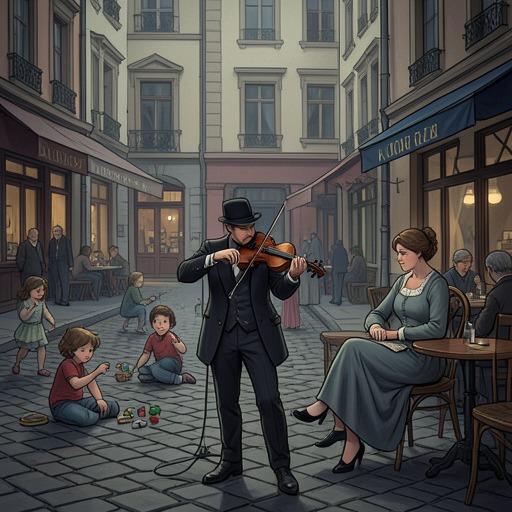
Antoni and Magda
Cartes Postales from GreeceAntoni and Magda’s connection is a one-night encounter in Kalamata, created and expressed through music rather than through promises of a lasting relationship. His violin transforms Magda’s habitual solitude into a moment of intense attention and shared feeling; by the following day he is gone, but the music and a violin string remain as tokens of an experience she accepts as brief and joyful.
An encounter at the seafront
Magda often spends time outside the café owned by her cousin Andreas, sitting alone by the port. The setting is usually quiet and familiar: the water is still, the warehouses hold dried fruit and olive oil, and only a few people linger near the boats. One evening, a sustained violin note breaks that silence. Magda turns toward it and sees a middle-aged man playing. He looks in her direction, though she cannot know whether he is playing for her or simply absorbed in the music. She nonetheless feels that the performance is addressed to her.
The response is immediate and unusually powerful. Magda is used to the bouzouki, the baglama, and dancing the Kalamatianos, but the violin’s melody holds her still. She closes her eyes to listen, attending not only to the notes but also to the spaces between them. Her reaction becomes physical before she can explain it: emotion rises, and she wipes away tears with a paper napkin. The scene establishes the basis of the connection as a form of recognition carried by music, not by prior acquaintance or extended conversation.
A public performance becomes personal
The violinist’s playing changes the social space around them. People stop, listen, and drop coins into his open case; the seafront fills, cafés become crowded, and the performance continues into the night. The music can be heard across the area, its quieter passages carrying over the still water and its louder moments cutting through conversation. Its public success matters to Magda, but her response is more intimate than the crowd’s: when the final note ends at around eleven thirty, she tells him that people loved him, while the narration clarifies that she is speaking most truthfully of herself.
Antoni redirects her praise toward the instrument, tapping the case as he credits the violin for what the listeners have heard. That modest answer does not undo Magda’s sense of personal connection; instead, it leaves room for the music to be both his craft and the medium through which she feels addressed. When he sits at the only spare chair at her table, the applause is still continuing. Their conversation begins within the aftermath of a performance that has drawn a crowd, yet the two people at its center are accustomed to being alone, and neither has someone waiting at home.
Learning the violin together
Magda asks how Antoni learned to play. He answers by describing the violin as an instrument whose music is already within it, waiting for someone to release the sound. His account makes playing seem less like display than attentive discovery, a conception that matches the way Magda has listened to the performance. She asks whether she could play as he does if she picked up the instrument. Rather than dismissing the possibility, he invites her to try.
Antoni opens the case and lifts the violin from its red velvet lining. He tunes it with small adjustments to the pegs, while Magda watches the carving on the scroll. He then shows her how to hold the instrument beneath her chin, position her left hand, and spread the fingers of her right hand along the bow. Guiding her elbow, he helps her feel the bow move across a string. The instruction is practical, but it also gives their encounter a new form: Magda is no longer only the listener to whom the music seems directed; she is invited to approach the instrument herself. Other people watch, so even this exchange remains partly within the public setting of the recital.
The final tune and the exchanged string
Later, Magda asks Antoni to play the first tune again. He agrees to play it for her, and the Bach Air sounds once more, now at her explicit request. The people of Kalamata listen without stirring until it ends. As the audience begins to leave, some notice Magda and the violinist sitting close together in conversation. Their closeness is visible, but the narrative does not turn it into evidence of a continuing partnership.
When Andreas eventually comes out of the café, he is carrying an industrial-sized tin filled to the top with coins left by customers for Antoni. The musician, however, has disappeared, and Magda is gone from the table as well. The next day, Andreas sees her in the street humming a tune he recognizes from the previous evening. Asked whether Antoni will return, she answers no. She wears a length of what looks like silver wire around her wrist and explains that it is the G string from his violin, which they exchanged as gifts. Asked what she gave him, she smiles and walks on, still humming the Bach melody. The exchange leaves one tangible object with Magda, while her undisclosed gift and enigmatic smile preserve something private about the encounter.
A brief connection that endures
The narration presents the meeting as a connection between two people that made them happy for one night, while carefully leaving its precise nature open. The narrator does not claim that Antoni made love to a woman in every town; instead, the possibility is framed as speculation about what might happen when he met someone whose response to music resembled Magda’s. Antoni’s route and his power to move listeners are set against Magda’s rootedness in Kalamata: he disappears, while she stays, carrying the tune into the next day. The account suggests attraction and intimacy without asserting a lasting romance or a shared future.
For Magda, the G string offers a durable reminder of a happiness she does not treat as spoiled by its transience. The narrator imagines her keeping it wrapped around her wrist, and contrasts her apparent joy in the experience itself with the pain that can attend love. This reflection also gives the episode a second significance: the narrator has avoided music because it intensifies personal sorrow, but hearing the story leads to downloading Bach sonatas, including the Air on a G String. Music thus links Antoni and Magda in the remembered encounter and reaches beyond it, becoming part of the narrator’s gradual return to listening. The episode’s emotional resolution is not reunion but retention: Antoni is gone, while the melody and the exchanged string allow the brief connection to remain present.